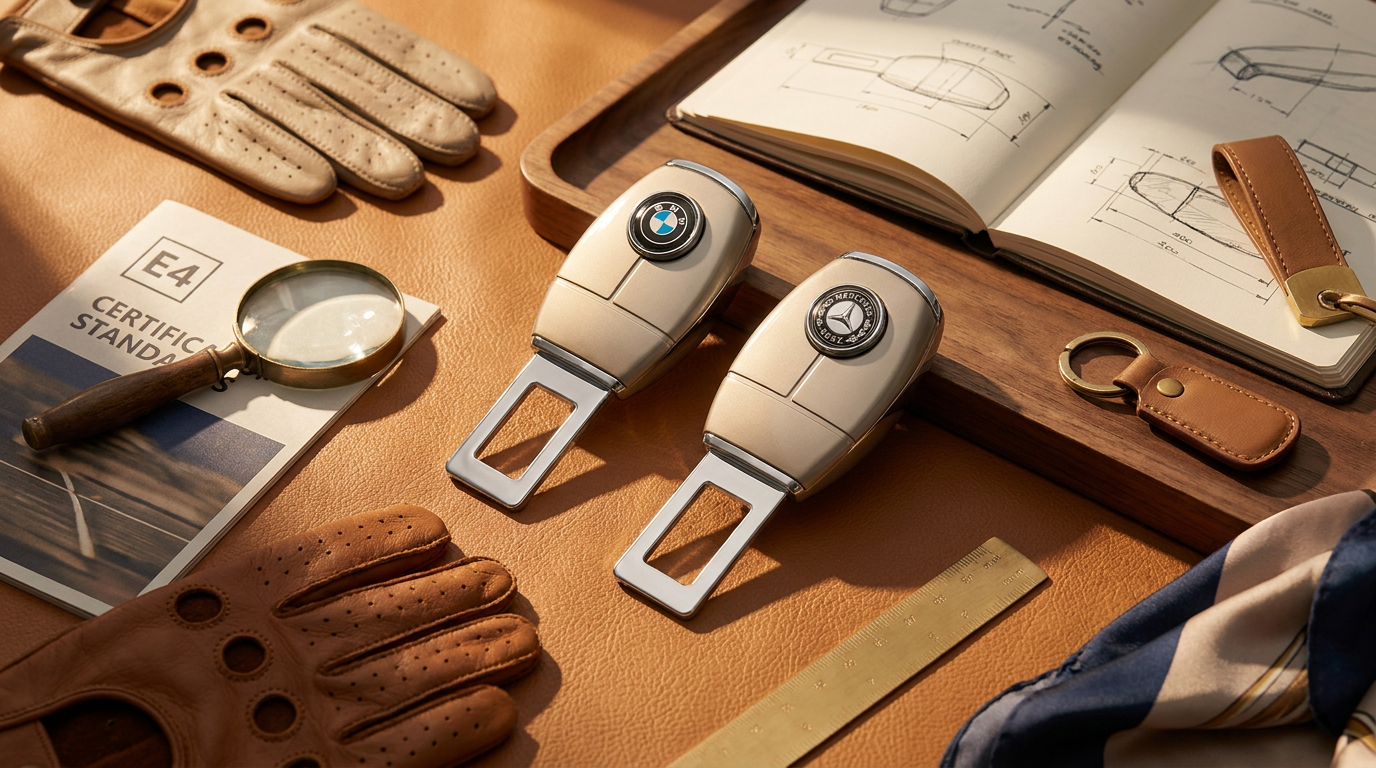
Verifying E4 Safety Certified Seat Belt Extenders
 Jordan HaleStaff Writer
July 1, 2026. Understanding the manufacturing standards behind an E4 safety certified seat belt extender is essential for ensuring vehicle occupant protection. This guide explores the technical requirements and certification processes that define reliable Adjustable Vehicle Seat Belt Extension hardware.
I remember the distinct, metallic click the first time I snapped a new extender into my driver's side buckle. It wasn't the hollow, tinny sound of cheap plastic; it was a heavy, reassuring thud that suggested the mechanism was built for tension, not just convenience. When looking for an adjustable seat belt extension for plus size users, that physical feedback matters because it reflects the engineering beneath the surface. The first thing I noticed was the weight of the steel tongue. In a world of lightweight components, there is a specific gravity to hardware that meets international standards. According to Seat Belt Extender Pros, quality extenders are sourced from E4 and E8 certified, DOT-registered manufacturers that maintain compliance with ISO/TS 16949:2009. This isn't just a string of alphanumeric codes; it is the framework that ensures a device can withstand the violent forces of a collision. When you are navigating the differences between an airplane seat belt extender vs car extender, these automotive-specific certifications become the line between a tool that works and one that fails under pressure.
The Adjustable Vehicle Seat Belt Extension addresses these safety concerns by utilizing materials that mirror original equipment manufacturer (OEM) specifications. It turns out that the E4 mark specifically refers to the Economic Commission for Europe (ECE) standards, with the number 4 indicating the testing occurred in the Netherlands. This level of scrutiny ensures the webbing has the appropriate tensile strength and the buckle mechanism won't release prematurely. I keep coming back to the importance of the "rigid" versus "flexible" debate found in many consumer circles. A rigid extender provides a fixed point of entry, which is often preferred for those who struggle with mobility, while a flexible version allows the buckle to lay comfortably against the hip. Regardless of the form factor, the internal locking pawls must be heat-treated steel. As noted in the E4 SAFETY CERTIFIED 3' Car Seat Belt Extender Review, seeing the certification stamp directly on the hardware provides the necessary peace of mind for daily commuting. Whether you are installing a universal seat belt extender for a temporary passenger or a permanent fixture, the mechanical integrity remains the same. The Adjustable Vehicle Seat Belt Extension is designed to bridge the gap without introducing a weak link into the vehicle's existing safety restraint system, maintaining the geometry required for the shoulder belt to cross the chest correctly.
Selecting the right extension requires a framework that moves beyond simple aesthetics to focus on technical compatibility. Somewhere around week two of testing different configurations, I realized that the most important factor wasn't the length of the extension, but the precise dimensions of the metal tongue. Even within a single manufacturer's lineup, buckle shapes vary significantly. You must ensure the extender is specifically labeled for your vehicle's make and model to prevent "false latching," where the buckle clicks but isn't fully secured. When you look at an adjustable seat belt extension for plus size needs, the goal is comfort, but the priority is the locking mechanism. Before finalizing a purchase for a universal seat belt extender, consult this checklist to ensure the hardware meets the necessary benchmarks:
- Verify the E4 or E8 certification mark is physically stamped or sewn into the product label.
- Measure the width of the metal tongue on your existing seat belt to match the extender exactly.
- Check for DOT registration of the manufacturer to ensure compliance with federal motor vehicle safety standards.
- Ensure the extender is not used in conjunction with a child car seat unless specifically approved by the car seat manufacturer.
- Inspect the stitching on flexible extenders for a high-density box-stitch pattern, which indicates reinforced strength.
- Confirm the buckle release button requires a standard amount of force to prevent accidental unlatching by clothing or bags.
“E4”, ECE, and U.S. standards — what they mean

An “E4” mark refers to European ECE type-approval, which is a different regime from U.S. federal rules. In the United States the governing standard is FMVSS No. 209 (49 CFR 571.209), and it applies to aftermarket seat belt assemblies too. A foreign approval mark does not by itself make an extender compliant for a U.S. crash-critical use — for that, use a manufacturer extender specified for your vehicle.